
Agriculture
Why Small Alternative Tropical Agriculture is the Best Investment Today
There has been a lot of talk about society and its many issues, and the extremities that may come.
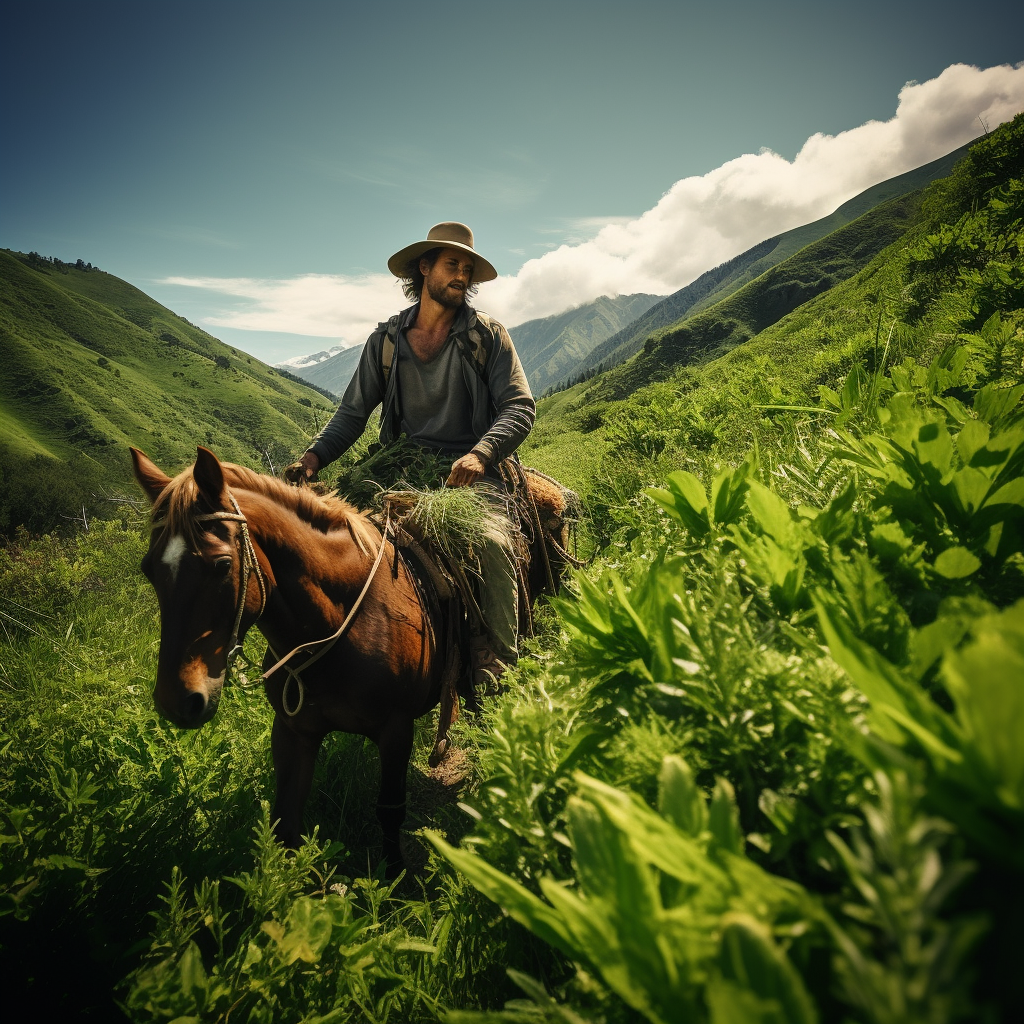
Welcome to the exciting world of small tropical agriculture investments! This is by far the smartest investment right now.
Today, I’m thrilled to present you with a golden opportunity that not only promises great financial returns but also contributes to sustainability, food security, and positive social impact. Investing in small tropical agriculture now could be your ticket to a greener future and a thriving portfolio. Let’s delve into the compelling benefits awaiting you:
- Booming Market Potential: The demand for tropical products is skyrocketing! As global consumers seek healthier, exotic, and sustainable alternatives, the tropical agriculture market is primed for substantial growth. By investing in this market now, you position yourself to ride the wave of increasing demand and reap the rewards of this lucrative opportunity.
- Diverse Product Range: Tropical regions offer a treasure trove of diverse crops, from luscious fruits like mangoes, pineapples, and papayas to sought-after spices and medicinal plants. Investing in small tropical agriculture grants you access to a broad range of products, reducing the risk associated with relying solely on one crop. Not to mention your family is the best-fed family there is.
- Premium Pricing for Quality: Sustainability and organic products command premium prices in today’s conscious consumer
 market. By adopting eco-friendly and socially responsible practices, small tropical farmers are better positioned to cater to discerning customers and secure higher profit margins.
 - Year-round Growing Season: Tropical regions enjoy a perpetual growing season, ensuring a continuous supply of fresh produce throughout the year. As an investor, this means consistent revenue streams, even when other agricultural regions face seasonal limitations.
- Climate Resilience: Climate change poses significant challenges to agriculture, but tropical regions tend to be more resilient. Agriculture in the tropics is much more productive, obviously. By investing in small tropical agriculture, you tap into a climate-resilient sector, reducing the vulnerability to extreme weather events and unpredictable growing conditions. You have to hear facts like this from the highly experienced consult; like that the equator is also a buffer zone of air purification, where weather patterns move hemispherical contaminants between this zone and their respective polls, making places like Panama and Northern Colombia potentially more valuable investments. Anyone preparing for a nuclear winter or similar would likely be interested in this range, and just so happens that the guy who told you this information has what’s available well mapped out (contact below).
- Government Support: Governments worldwide are increasingly promoting sustainable agriculture, offering financial incentives, tax breaks, and grants to support farmers. Your investment in small tropical agriculture could qualify for various government schemes, further enhancing your returns. Carbon credits anyone?
- Positive Environmental Impact: Small tropical agriculture often embraces eco-conscious practices like agroforestry, permaculture, and sustainable water management. By investing in such projects, you actively contribute to environmental conservation and carbon sequestration, making a real difference in the fight against climate change. We are always to help new farmers with organic processes, new species, and design input. If certain new cutting-edge practices we have learned are employed new farmers will be “off to the races.”
- Empowering Local Communities: Small-scale agriculture fosters community development by creating employment opportunities and empowering local farmers. Your investment can directly uplift livelihoods, improve education, and enhance healthcare in tropical regions.
- Access to Niche Markets: Tropical products often cater to niche markets seeking unique flavors and exotic experiences. By investing in small tropical agriculture, you open doors to high-value specialty markets that offer distinct advantages over mass-produced commodities.
- Technology Advancements: The agricultural sector is undergoing a technological revolution. Investments in small tropical agriculture can benefit from cutting-edge innovations in precision farming, automated irrigation systems, and data-driven decision-making, optimizing productivity and efficiency.
- Personal Fulfillment: Beyond financial gains, investing in small tropical agriculture provides intrinsic rewards. Knowing that your investment contributes to sustainable practices, supports local communities, and fosters responsible consumption can be deeply gratifying.
 Small tropical agriculture is a no-brainer today, with everything going on in the world, and the risks of city life increasing by the minute, there is no more solid a “plan b,” than your own tropical production.,ming a king’s feast nightly is not a bad second option should electric blackouts, currencies crash, or whatever other nightmare ensue.
“Who am I going to do this with, since I know nothing about it,” you ask? Well, it should be someone with at least a decade of experience and experience on over 60 farms. If it could be someone with a cutting-edge mentality and recipe for this that has been recognized by agriculture associations worldwide and has his own spear-tipping book to go with the skills, that would be ideal. It should be someone who knows the tropical terrain, and the local marketplace all the way through to the oligarchy cause they are certainly customers for this production level. It should be someone known to take on big projects with an iron discipline, that result in explosive success.
Turns out this is our exact script. We can manage (if needed) progressive diverse agriculture in our region, under simple expansions of our management system. Secure your spot in this forever steadily thriving market, reap financial rewards, and be part of a transformative movement toward a sustainable future. Join us now, and together, let’s grow a brighter tomorrow through small tropical agriculture!
Our team specializes in Central & South America permaculture management. This is also a smart idea being that one can physically get here by sail or by trail, at least in the case of any sort of major crisis where major transportation systems are not operating.
Now is the time, and frankly, who knows how much time is left?
Your message has been sent

We see lots of people debating on currency fluctuations, and the intelligence in gold and silver investments. Now is the time to turn wealth into small agriculture.

Agriculture
NUTRITIONAL DIVERSITY SUPPLEMENTS
Agriculture
“Save the Planet” Drone Powered [Guerrilla Permaculture]
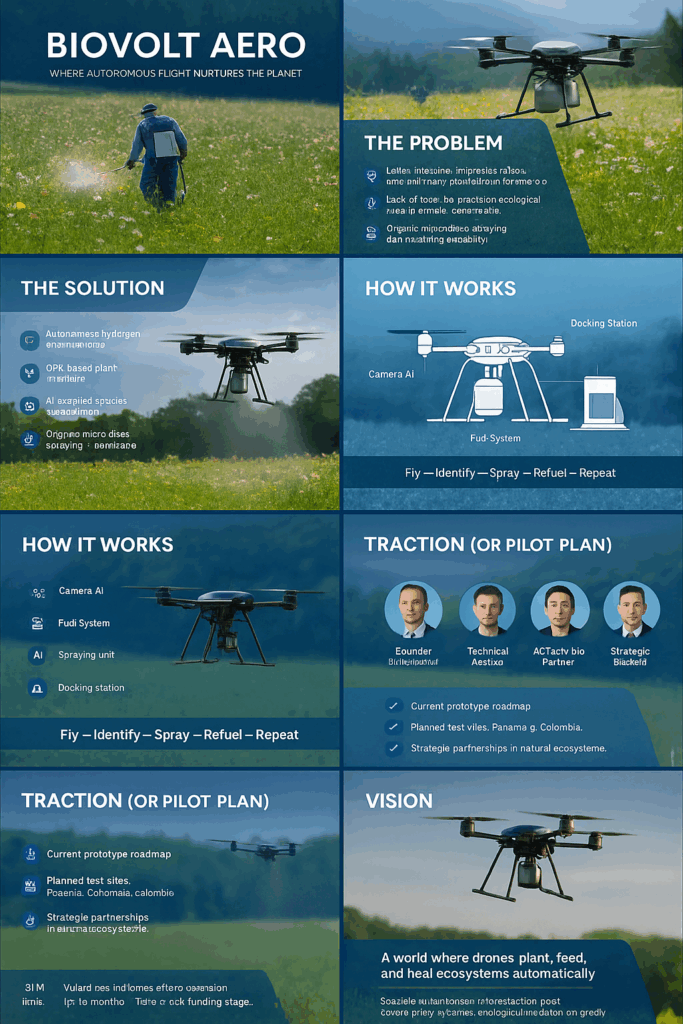
In an era where ecological regeneration is no longer optional but essential, BioVolt Aero (working title) introduces a breakthrough in autonomous environmental care. Leveraging hydrogen fuel cell technology (beginning models would be battery), precision AI, and biomimicry-inspired design, our drones do more than fly — they heal. They map remote ecosystems with GPS precision, identify botanical species in real time, and deliver targeted applications of organic fertilizers, all while emitting zero carbon. Every flight is a step toward revitalizing degraded lands, empowering permaculture systems, and rewilding the planet autonomously. We use long known all nature indegioenous taught compisitions, as well as super-powered, new, Nutritional Diversity optimal versions of organic applications/preperations.
Designed for the frontlines of ecological transformation, BioVolt Aero operates without compromise. With an integrated docking and refueling system, our drone technology forms a closed-loop solution capable of operating in the most remote, rugged, and biodiverse environments on Earth. Whether it’s jungle permaculture in Panama, high-altitude plots in Colombia, or experimental food forests worldwide, BioVolt Aero provides precision care with minimal human input. This is not just agricultural tech — it’s regenerative intelligence in motion.
BioVoltair is the self-charging, GPS-precise field drone built to grow abundance where tractors can’t. Each unit launches from a solar “nest,” flies RTK waypoint routes with 2–3 cm accuracy, and hot-swaps payload pods for foliar feeding, dry solids dropping (seed-balls, biochar, inoculants), or selective harvesting. The result is continuous, surgical care—night or day, in steep, wet, or sensitive terrain—without soil compaction, road cuts, or wasted inputs. Think variable-rate teas on stressed zones at dawn, seed-ball corridors by afternoon, and crown-level harvests at dusk—all from the same autonomous fleet.
For operators, that precision translates into outcomes: 20–40% input savings, 5–15% yield lift in season, and brand-new resource streams from rapid interplanting and reforestation—fruit, leaves, resins, timber, carbon. A 10-drone swarm can treat 100+ hectares per day, place tons of beneficial solids monthly, and document every drop and seed with GPS time-stamps for organic/regenerative audits. If you’re ready to scale regenerative production with lower costs, higher biodiversity, and real-time proof of impact, equip your land with BioVoltair and start growing ecosystems like software.
Executive Summary: BioVolt Aero is a regenerative technology company pioneering the use of hydrogen-powered, AI-assisted autonomous drones for ecological restoration and enhancement, organic agriculture, and precision botanical care. Our drones identify, monitor, and nurture plant life through GPS-guided missions, delivering micro-dose organic fertilizers and operating on a closed-loop hydrogen refueling system. Designed to serve remote landscapes and degraded ecosystems, BioVolt Aero offers an emission-free, intelligent alternative to conventional land management systems.
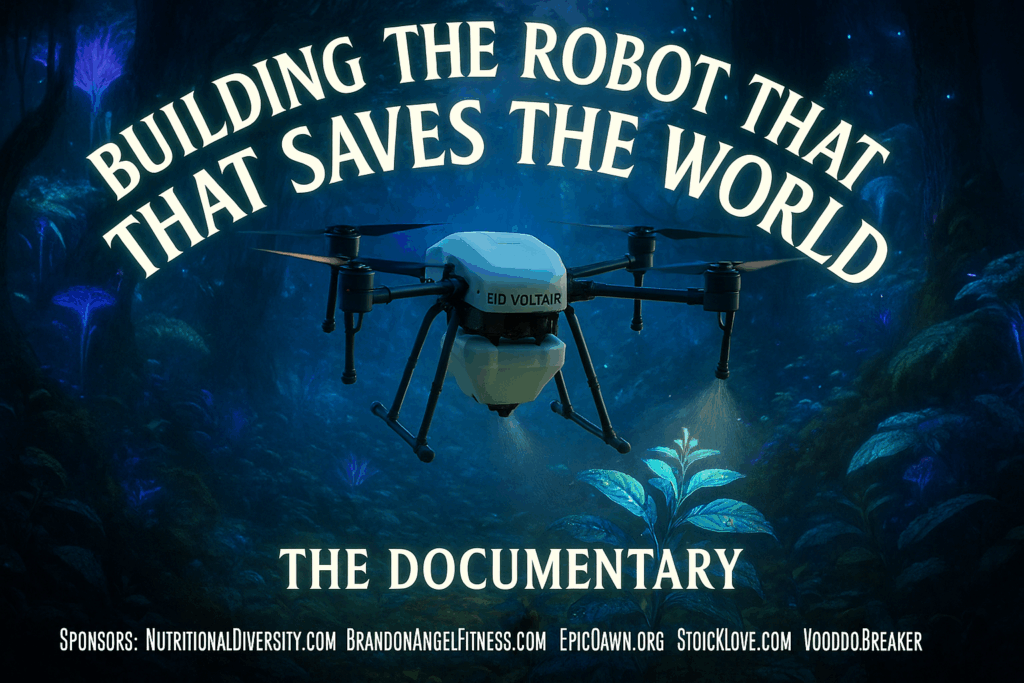
Mission Statement: To accelerate the planet’s ecological recovery and enhancement throughintelligent, autonomous technologies that care for nature with zero emissions and maximum precision and effect.
Problem Statement:
- Remote environments are difficult and costly to manage or enhance
- Traditional agricultural methods are carbon-intensive and imprecise, and outright toxic to everything and everyone
- Regenerative agriculture and permaculture lack scalable tools for monitoring and micro-treatment
- Current drone technology lacks full autonomy, organic compatibility, and sustainable energy systems behind a system made from nature, natural practice, and life.
- In our last 15 years of jungle study, we have realized a whole level of potential in the human-to-nature relationship, and we see this as a vehicle to catch us up to where we should have been truly!
Solution: BioVolt Aero combines hydrogen fuel cell technology with AI-powered plant recognition, creating a drone system capable of:
- Autonomous flight using RTK GPS and obstacle detection
- Real-time plant ID and health analysis via onboard camera and AI
- Precision spraying of organic fertilizers
- Autonomous return and docking at hydrogen and nutrient refueling stations
Product Features:
Model I
This will be the first development of a consumer product for the homeland and the home indoor area. Each of these models also gives us the chance to develop our Plant Recognition Optics and Computer, as well as GPS positioning in a battery-powered, self-recharging, and refueling unit that delivers all-natural ecological enhancements to a far more robust, strong, and fruitful on-site ecosystem. The indoor and outdoor home agrodrones both have long roads of head of them with new development and added features aiding in things like best oxygen levels and quality, and even security for pets and family, and from toxic elements, gases, and intruders.
Model II
This is where things really begin to take off! We can work magic on certain natural areas with the help of the Bio Voltair Final Model. The impact of this development.
- Hydrogen fuel cell for long-duration, zero-emission flights
- High-resolution AI camera system for species recognition
- Precision liquid application system
- Modular design for expansion into seeding, sampling, and surveillance
- Fully autonomous docking/refueling architecture
Target Markets:
- Pioneers of a new human-to-nature culture of a miraculous degree [invite]
- Regenerative agriculture farms –
- Permaculture and food forestry projects
- Government and NGO reforestation programs
- Private land conservationists
- Ecological restoration contractors
Business Model:
- Hardware Sales: Drones and docking stations, organic formulations, mixing equipment, and fixed systems
- Subscription SaaS: AI mapping and ecosystem analytics dashboard
- Refill Logistics: Organic inputs, batteries, and hydrogen cartridges
- Data Licensing: Ecological data to research institutions and climate orgs
Traction Plan (Next 12–18 Months):
- Q3: Finalize prototype and onboard AI models
- Q4: Test flights in Panama (food forest zones)
- Q1: Deploy in Colombia for pilot customer programs
- Q2: Begin manufacturing and training operator partners
- Q3–Q4: Launch dashboard beta and input refill subscriptions
Team:
- Brandon– Team Captain, Ecological Enhancement
The name BioVoltAir is with a favorite quote in mind by VOLTAIR and that is “We are guilty of the good we do not do.”
And there is no doubt we must do this.
- Dr. Richard, E#### – Aerospace Engineer, PhD, current Pentagon Contractor
- [AI/ML Specialist] – Computer vision for plant recognition
- [Operations ] – Logistics, pilot deployments [ChiefBrandon]
- Current Advisors: Include Biotech green energy excecutives, experienced Permaculture legends, Aerospace experts, and working Agricultural, and Mechanical Engineers
Competitive Advantages:
- Battery Powered (self-charging in a programmed route providing a continuous 24/7 working symbiotic enhancements – highest growth rates and strengths ever!) consumer marketplace income
- Hydrogen power ( the next level, longer range, no recharging downtime, highly capable machines), commercial governmental marketplace income
- Closed-loop autonomy (flight + identify + care + refuel)
- Organic and ecosystem-safe payload compatibility
- Real-time data collection and mapping
- Designed for remote deployment
Funding Requirements:
- Ask: $650,000 Seed Round
- Use of Funds:
- 40% R&D and engineering
- 30% Prototyping and pilot testing
- 20% Team expansion
- 10% Legal, IP, and operational setup
Our first drone model
Vision: To deploy millions of intelligent drones across the planet — drones that do not surveil or destroy, but regenerate. With BioVolt Aero, we envision a future where technology partners with nature to create balance, abundance, and ecological restoration at scale.
Hydrogen Fuel Cell Drone for Botanical Management
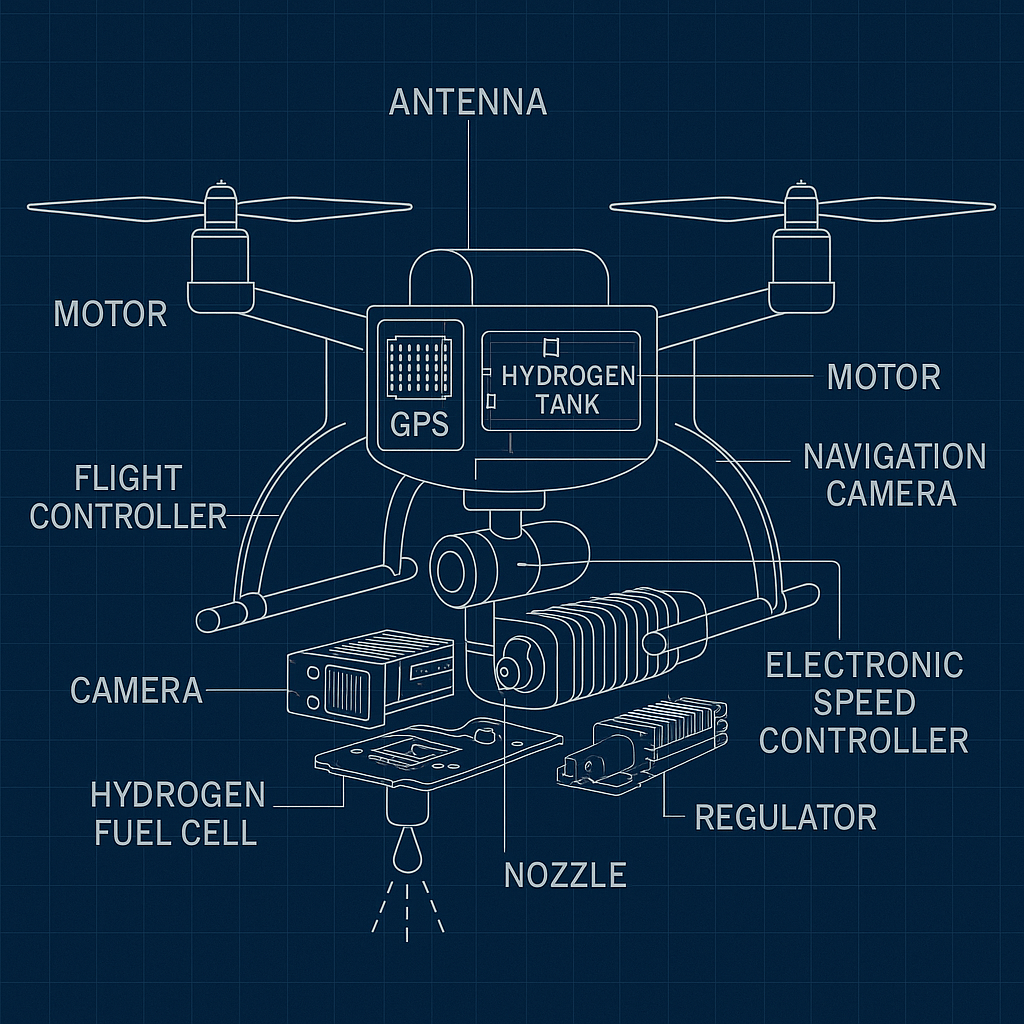
Project Name (Proposed): Aerobotany
Overview:
An autonomous hydrogen-powered drone designed to identify, monitor, and care for plant species in diverse environments using precision GPS, AI-based visual recognition, and organic nutrient spraying. It autonomously refuels at dedicated hydrogen and fertilizer stations, enabling long-range, sustainable operations in remote areas.
System Components
1. Propulsion & Power:
- Fuel Source: PEM Hydrogen Fuel Cell
- Energy Management: Lightweight lithium-ion buffer battery for peak loads
- Propulsion: Quad-rotor or hex-rotor architecture
2. Navigation & Mapping:
- System: RTK-enabled GPS module (e.g., u-blox F9P)
- Additional: IMU (Inertial Measurement Unit), barometer, magnetometer
- Autonomy: Path planning via QGroundControl or custom AI layer
3. Botanical Identification:
- Camera: RGB + optional multispectral lens
- Processor: NVIDIA Jetson Nano or Xavier NX
- Model: YOLOv8 or MobileNet trained on local flora dataset
- Capability: Plant species recognition, health diagnostics, maturity estimation
4. Organic Fertilizer Application:
- Tank: 1-2L bladder with quick-disconnect fitting
- Sprayer: Peristaltic pump with precision nozzle
- Trigger: Vision system decision logic initiates spray
5. Refueling & Docking Station:
- Fuel System: Replaceable hydrogen cartridges or high-pressure refill line
- Fertilizer System: Refillable bladder tank with auto-docking connector
- Navigation: AprilTags or beacon-based landing zone
- Charging: Backup solar-assisted electric charging panel
Functional Workflow
- Pre-mapped GPS route is uploaded to the drone
- Drone autonomously navigates and identifies species
- AI determines health/treatment needs
- Fertilizer is sprayed as required
- Flight data and plant analysis is logged
- Drone returns to station for hydrogen & fertilizer refill
- Data uploaded to the central ecological management system
Key Benefits
- Zero-emissions, high-efficiency hydrogen propulsion
- Botanical intelligence for ecological monitoring
- Precision organic treatment with minimal waste
- Operates in remote/agroforestry/permaculture zones
- Supports guerilla permaculture and scalable rewilding
Phased Development Roadmap
Phase 1: Concept & Design (0-3 months)
- Finalize drone specs
- Create initial marketing material to raise funds for Phase 2 [Drone Build] COMPLETE [Agriculture Drone Kickstarter]
Phase 2: Prototype Testing (4-8 months)
- Build and test a basic drone with an onboard computer
- Conduct test flights with a dummy payload
- Refuel and fertilizer spray test
Initially, we will be building battery-powered, blanket-spray, ecological area-enhancing models.
Phase 3: Autonomous Integration (9-12 months)
- Enable AI navigation + spray decisions
- Train model with new datasets
- Test complete flight/refuel cycles
This model should be left prepped for more targeted visuals and more GPS-based maneuvers.
Phase 4: Deployment (12+ months)
- Field deployment in jungle/agroforestry sites
- Data integration with ecological platforms
- Refined scale-up for multiple units
1. Core Functionalities
-
Autonomous Flight using GPS + AI-assisted obstacle avoidance
-
Camera-Based Botanical and Elemental Identification (e.g., plant species, animal species, nature changes, river mapping, health measurements, growth stages)
-
Liquid Organic Fertilizer Delivery System
-
Hydrogen Fuel Cell Propulsion
-
Autonomous Refueling Station
2. Component Breakdown
A. Hydrogen Fuel Cell System
-
Type: PEM (Proton Exchange Membrane) fuel cell – lightweight and suitable for drones
-
Tank: Compressed hydrogen cylinder (potentially replaceable or refillable)
-
Power Management: Must support camera, GPS, AI chip, spray pump, and flight
-
Challenge: Weight-to-energy ratio; ensuring the total payload (fertilizer + equipment) stays light
B. Navigation & Mapping
-
RTK GPS Module: High-precision location system (cm-level accuracy)
-
Pre-mapped Routes: Based on ecological trails or permaculture layouts
-
AI-based dynamic re-routing: Optional real-time route adjustment
C. Plant ID & Health Detection
-
Camera: RGB + optional multispectral or thermal for health diagnostics
-
AI Model: Trained on a local dataset of regional plant species
-
Real-time recognition: TensorFlow Lite, PyTorch Mobile on edge device like NVIDIA Jetson Nano or Coral Edge TPU
D. Spraying System
-
Pump: Low-volume precision sprayer
-
Tank: Lightweight bladder tank (refillable at the station)
-
Targeting: AI-based targeting once the species is identified
E. Refueling & Recharging Station
-
Hydrogen Refilling Dock: Replaceable hydrogen cartridges or high-speed refill nozzle
-
Organic Fertilizer Tank Refill
-
Landing Pad with Visual Markers or Wireless Beacon
References
- BioVoltAir Home Agriculture Drone Business Plan
- BioVolt_Aero_Pitch_Deck_Graphic
- Nutritional_Diversity_Business_Plan
Can and should be used in conjunction with the following programs and related potentials.
TECHNICALS
BioVoltair: Self-Charging Field Drones for Regenerative Scale
What it is
A family of modular, autonomous ag-drones that:
-
Self-charge at solar “nests” (contact rails or inductive pads with battery banks) and/or swap packs at cache stations.
-
Fly RTK-GNSS waypoint missions (2–3 cm accuracy) with sensor-guided variable-rate application.
-
Hot-swap payload pods: foliar sprayer, dry solids spreader/“seeder,” and selective harvester.
Why it matters
Traditional machinery compacts soil, wastes inputs, and can’t reach steep, wet, or ecologically sensitive ground. BioVoltair swarms deliver precision care with almost zero soil impact, creating more biomass, more biodiversity, and more food—faster and cheaper.
Core Capabilities
1) Foliar Feeding (Liquids)
-
Tank pods: 10–30 L (class-dependent), 50–120 µm droplet spectrum for leaf uptake and microbial teas.
-
Throughput: ~8–20 ha/hour per drone (crop and rate dependent) with variable-rate maps from NDVI/multispectral scans.
-
Benefits: 20–40% input savings via targeted dosing; faster recovery after stress; higher Brix and micronutrient density.
2) Solids Dropping (Seeds, Inoculants, Biochar, Pellets)
-
Hopper pods: 15–30 kg; auger or spinner plates with adjustable gates.
-
Throughput: 100–250 kg/hour per drone (material-dependent).
Example: 10 drones placing 1.0–2.5 t/day of seed-balls, mycorrhizae, or biochar while mapping take. -
Benefits: Rapid reforestation/intercropping without bulldozers; creates new resource flows (timber, fruit, medicine, resins) and carbon sinks.
3) Selective Harvesting (High-Value Light Picks)
-
End effectors: soft-grip berry picker, moringa/tea leaf clipper, spice pod clip, pollen/flower collection; vision-guided.
-
Use cases: hillsides, terraces, fragile soils, and tree-crown sampling where ladders/tractors are unsafe.
-
Benefits: Harvest otherwise “lost” yield; quality picks at ideal ripeness windows (night/dawn missions).
Autonomy & Self-Charging
-
Solar Nest Dock: 1.5–3 kW PV + LiFEPO₄ pack + weatherproof charge pad; contact-rail or inductive landing; 30–60 min top-up cycles (class/pack dependent).
-
Battery Cache Option: low-cost swap lockers; robotic arm or human swap in under 60 s.
-
Mesh Comms: LoRa for health/telemetry, 5 GHz for video/payload, optional sat-backhaul; automatic relay via ridge repeater.
-
Swarm OS: time-windowed waypoint queues, collision avoidance, and recipe engine (e.g., “Tea A at 25 L/ha on NDVI<0.62 zones”).
Sensing & Precision
-
RTK-GNSS + vision-based landing (2–3 cm).
-
Multispectral/thermal for canopy vigor, water stress, pest heat signatures.
-
LiDAR light for 3D canopy/terrain maps and safe under-canopy passes.
-
Closed-loop control: sensor maps → prescription layers → live variable rate.
Environmental & Production Benefits
-
Zero soil compaction; preserves structure, fungi, and water infiltration.
-
50–80% less water vs. ground rigs for foliar work (fine droplets, night missions).
-
Chemical reduction via targeted biostimulants and microbial teas; better IPM.
-
Access everywhere: steep slopes, wet seasons, wildlife corridors (no road cuts).
-
Biodiversity uplift: fast interplanting/seedballing creates multi-strata food forests, compounding yield year-over-year.
Example Daily Outputs (illustrative, per favorable conditions)
-
Foliar feeding: One 20 L-class drone treats 10–15 ha/day at moderate rates; 10 drones = 100–150 ha/day with variable rate.
-
Solids dropping: One hopper drone places ~150 kg/day of seed-balls/inoculant; 10 drones = 1.5 t/day (≈100k–200k seed-balls depending on mass).
-
Selective harvest: A soft-grip picker drone can clear 40–80 kg/day of high-value berries/leaves from difficult terrain (fleet scales linearly).
Economics (rule-of-thumb)
-
Fleet (10 drones + 4 nests + spares): capex ~“mid five to low six figures” (config dependent).
-
Operating cost: electricity from solar + light maintenance; $3–8/ha foliar opex typical at scale.
-
Payback levers:
-
Input reduction (20–40%)
-
Yield lift (5–15% first season; more with biodiversity compounding)
-
New product streams from rewilding (fruit, resins, timber, medicinal leaves)
-
Carbon/biomass credits (biochar + reforestation)
→ 12–24-month payback is common in mixed operations.
-
Safety & Compliance
-
Geofencing + dynamic no-fly zones; ADS-B in where required.
-
Redundant power + parachute (octo class); auto-return on wind/rain thresholds.
-
Traceability: every drop/seed/harvest point is GPS-time-stamped for audits and certifications (organic, regenerative, biodiversity).
Product Line (example)
-
BioVoltair SCOUT – mapping/NDVI/thermal; 45-min endurance.
-
BioVoltair FEEDER – 10–30 L foliar pod; variable-rate micro-mist.
-
BioVoltair SOWER – 15–30 kg hopper; seed-ball/biochar/inoculant spread.
-
BioVoltair HARVEST – soft-grip/clipper head for berries, tea, moringa, spice pods.
-
Solar NEST – autonomous charge dock with mesh gateway and weather station.
Strategic Impact
BioVoltair lets you grow ecosystems like software: schedule tasks, push “recipes,” receive telemetry, and iterate weekly. The result is vast, decentralized alternative agriculture—food forests, fiber corridors, resin groves, and medicinal understories—that produce tons of natural resources while healing soil and water. No bulldozers. No compaction. Just precise, continuous care.
Growth Rate Expectations
Agriculture
Ciclo de Financiamiento del Fondo para el Medio Ambiente Mundial
ATENCIÓN: BANCO MUNDIAL
1818 H Street, NW Washington, DC 20433, EE.UU.
Tel: (202) 473-1000
Propuesta para el Ciclo de Financiamiento del Fondo para el Medio Ambiente Mundial (GEF-8)
Presentado por:
Brandon Angel
Fundador, Estudio de Rendimiento Biodiverso de la Diversidad Nutricional
Agricultor Alternativo Pro-Orgánico, Investigador y Especialista en Mejora Ecológica
Resumen Ejecutivo
El Programa de Mejora Ecológica de la Diversidad Nutricional (NDEEP) es una iniciativa revolucionaria de restauración ecológica diseñada para combatir la pérdida de biodiversidad, mejorar la salud del suelo y los océanos, regenerar ecosistemas degradados y fortalecer la resiliencia climática mediante sistemas agrícolas de alta diversidad y estrategias de rewilding (reintroducción de la vida silvestre).
A través del uso de enmiendas probióticas para el suelo, principios de permacultura y biodinámica, reforestación asistida por drones y mapeo ecológico con inteligencia artificial (IA), este programa busca fortalecer los ecosistemas existentes, restaurar tierras degradadas, regenerar puntos críticos de biodiversidad y crear sistemas alimentarios ricos en nutrientes que beneficien tanto la salud humana como la recuperación planetaria.
Con más de 12 años de experiencia en agricultura alternativa y estudios naturales en América Latina, he desarrollado un sistema innovador que restaura suelos empobrecidos, promueve cultivos orgánicos de alto rendimiento y revitaliza ecosistemas nativos, mejorando simultáneamente la nutrición humana. Cuento con un equipo diverso de expertos y sitios listos para su implementación.
Este Proyecto Alinea con las Prioridades Clave del GEF-8
✅ Restauración de la Biodiversidad y Prevención de la Pérdida de Especies mediante modelos agrícolas basados en ecosistemas altamente diversos.
✅ Mitigación del Cambio Climático mediante el aumento de la captura de carbono a través de prácticas regenerativas de agricultura y reforestación.
✅ Reducción de la Contaminación y Regeneración del Suelo al eliminar insumos sintéticos y utilizar compost enriquecido con microorganismos.
✅ Mejora de la Salud de los Océanos y del Agua previniendo la escorrentía agrícola y rehabilitando ecosistemas acuáticos con sistemas de filtración basados en algas.
El NDEEP es escalable, medible y replicable a nivel mundial, convirtiéndolo en un proyecto de alto impacto alineado con los objetivos de desarrollo sostenible del Banco Mundial.
Objetivos del Proyecto
🌱 Regeneración de la Biodiversidad y Mejora Ecológica
- Reintroducir especies vegetales nativas en áreas degradadas.
- Integrar corredores de vida silvestre y zonas amigables para los polinizadores.
- Utilizar drones para la dispersión de semillas y acelerar la reforestación.
- Establecer sistemas de suelo bioactivos permanentes para revitalizar tierras agrícolas degradadas.
🌍 Captura de Carbono y Resiliencia Climática
- Implementar modelos de permacultura y bosques de alimentos que actúan como sumideros de carbono a largo plazo.
- Restaurar bosques de manglares, turberas y ecosistemas costeros para proteger contra inundaciones y erosión.
- Desarrollar métodos de cultivo altamente diversos para incrementar la resistencia a sequías y fenómenos climáticos extremos.
♻️ Regeneración del Suelo y Eliminación de la Contaminación
- Sustituir fertilizantes y pesticidas sintéticos con enmiendas probióticas y biofertilizantes microbianos.
- Aplicar micorremediación (uso de hongos) para descontaminar suelos afectados por desechos industriales.
- Implementar ciclos de compostaje cerrados para transformar desechos orgánicos en nutrientes para el suelo.
🥦 Diversidad Nutricional para la Seguridad Alimentaria y la Salud Humana
- Establecer sistemas regenerativos de producción de alimentos altamente nutritivos con especies raras e indígenas.
- Fomentar dietas biodiversas y naturales que mejoran la salud del microbioma intestinal y el sistema inmunológico.
- Introducir proteínas sostenibles a través de agroforestería con ganado en sistemas regenerativos y proteínas alternativas.
🤖 Tecnología e Innovación para el Impacto a Gran Escala
- Desplegar sistemas de monitoreo ecológico con IA para rastrear el progreso de la biodiversidad.
- Utilizar drones y satélites para evaluar el éxito de la reforestación y la captura de carbono.
- Desarrollar aplicaciones móviles y seguimiento basado en blockchain para promover la adopción global de prácticas agrícolas ecológicas.
Ubicaciones Propuestas del Proyecto
La iniciativa NDEEP será piloto en América Latina, aprovechando 12 años de experiencia en Panamá, Colombia y Argentina. Las regiones objetivo incluyen:
- Zonas tropicales deforestadas en Panamá → Reforestación con modelos de agroforestería y permacultura.
- Ecosistemas costeros en Colombia → Restauración de bosques de manglares y biodiversidad oceánica.
- Tierras agrícolas degradadas en Argentina → Regeneración de suelos con probióticos y agricultura permacultural.
Las futuras expansiones incluirán Southeast Asia, África y América del Norte para escalar el impacto globalmente.
Plan de Implementación y Cronograma
| Fase | Actividades | Duración |
|---|---|---|
| Fase 1 | Selección y mapeo de ecosistemas degradados | 6 meses |
| Fase 2 | Implementación de sistemas agrícolas regenerativos | 1 año |
| Fase 3 | Reforestación a gran escala con drones | 1 año |
| Fase 4 | Estudio sobre Diversidad Nutricional y Salud Humana | 1 año |
| Fase 5 | Expansión global y escalamiento | Continuo |
Solicitud de Financiamiento
Para implementar con éxito la fase piloto, solicitamos $10 millones de USD del ciclo de financiamiento GEF-8 del Banco Mundial, distribuidos de la siguiente manera:
💰 $3M-30-300 → Restauración de tierras, reforestación y agroforestería.
💰 $2.5M =25=250 → Despliegue tecnológico (IA, drones y blockchain).
💰 $2M-20-200 → Investigación sobre el impacto de la diversidad nutricional en la biodiversidad y la salud humana.
💰 $1.5M -15-150 → Programas de capacitación y educación comunitaria.
💰 $1M -10-100 → Costos administrativos, operativos y logísticos.
Con este financiamiento, el Programa de Mejora Ecológica de la Diversidad Nutricional establecerá un modelo escalable para la recuperación ambiental global, impactando la biodiversidad, la resiliencia climática y la salud humana.
Conclusión
Al invertir en el Programa de Mejora Ecológica de la Diversidad Nutricional, el Banco Mundial y el Fondo para el Medio Ambiente Mundial estarán apoyando una solución innovadora basada en la naturaleza que revitaliza ecosistemas degradados, mejora la biodiversidad, fortalece la salud humana y combate el cambio climático.
Este no es solo un proyecto de conservación, sino un enfoque holístico para la restauración global, integrando sistemas alimentarios, ciencia ecológica y tecnología regenerativa para un planeta más saludable y resiliente.
Presentado por:
Brandon ‘Angel’ R.E.
Fundador, Instituto de Rendimiento Biológico Óptimo de la Diversidad Nutricional
Especialista en Agricultura Alternativa y Mejora Ecológica

Protected: Breaking Brands

Machines for Nature the industrial war complex should switch to building

THE NUTRIENT WEAVER

A Culture of Complete Optimization
Nutritional Diversity Ecological Enhancement Program (GEF)
Complete Optimization
Optimal Future Design Manual
Business Plan: BioVoltair Home Garden Drone

NUTRITIONAL DIVERSITY SUPPLEMENTS

Best Ashwagandha Rankings, Benefits & Experience

“Save the Planet” Drone Powered [Guerrilla Permaculture]

Interview Request – A New Paradigm for True Freedom & Resilience

Nutritional Diversity Ecological Enhancement Program (NDEEP)
Modern Agriculture Chemicals Directly Related to Human Sickness
Diverse Diet Studies & Mentions * A 2025 Overview
Ciclo de Financiamiento del Fondo para el Medio Ambiente Mundial

Best Hot Peppers, The Many Benefits, Rankings, Side Effects & Experience

How We Can Prevent The California Wildfires from Happening Again & Make Money & Enhance Life
Master Work, Wizard on the Hill, What does the old Kung Fu-er Really Have to Say?

Best Cordyceps Mushrooms, Benefits & Experience
Best Ashwagandha Rankings, Benefits & Experience
Best Hot Peppers, The Many Benefits, Rankings, Side Effects & Experience
Nutritional Diversity Ecological Enhancement Program (NDEEP)
“Save the Planet” Drone Powered [Guerrilla Permaculture]
Nutritional Diversity Ecological Enhancement Program (GEF)
Modern Agriculture Chemicals Directly Related to Human Sickness
How We Can Prevent The California Wildfires from Happening Again & Make Money & Enhance Life
Diverse Diet Studies & Mentions * A 2025 Overview
Ciclo de Financiamiento del Fondo para el Medio Ambiente Mundial
Interview Request – A New Paradigm for True Freedom & Resilience
Optimal Future Design Manual
NUTRITIONAL DIVERSITY SUPPLEMENTS
Business Plan: BioVoltair Home Garden Drone
Complete Optimization
A Culture of Complete Optimization
Machines for Nature the industrial war complex should switch to building
THE NUTRIENT WEAVER
Protected: Breaking Brands

Guerrilla Permaculture : A Look At Unstoppable Alternative Food Ecologies

Best Boxing Gear Rankings, Benefits, Side Effects & Experience

Best Avocado, Aguacate Rankings, Benefits & Experience

Best Garlic Vine Rankings, Benefits, Side Effects & Experience

Best Animal Permaculture Integration Technique Using Simple Solar Fences

for kids

-
 Special Elements6 years ago
Best Garlic Vine Rankings, Benefits, Side Effects & Experience
-
 Special Elements3 years ago
Best Pre-Workout Supplement Rankings, Benefits, Side Effects & Experience
-
 Special Elements3 years ago
Best Cassava Manioc, Rankings, Benefits, Cancer Cure & Experience
-
 Special Elements4 years ago
Best Glutamine Rankings, Benefits, Side Effects & Experience
-
 Special Elements5 years ago
Best Ambrosia, Wormwood Rankings, Benefits, Side Effects & Experience
-
 Special Elements6 years ago
Best Culantro Rankings, Benefits, Side Effects & Experience
-
 Special Elements6 years ago
Best Jackfruit Rankings, Benefits, Side Effects & Experience
-
 Special Elements4 years ago
Best Katuk Rankings, Benefits, Side Effects & Experience